

The Edge of Modern.
In The Edge of Modern, Dean Mitchell captures a moment of quiet transition. The painting reflects a landscape where older rural traditions still endure, even as modern methods reshape how people live and work on the land. Mitchell’s brushwork moves to the very boundary between realism and abstraction—so concise that a single removed stroke might cause the scene to dissolve into geometry. Yet the barn remains steady on the horizon, enduring and grounded, a quiet witness to generations who have lived and labored on the land.
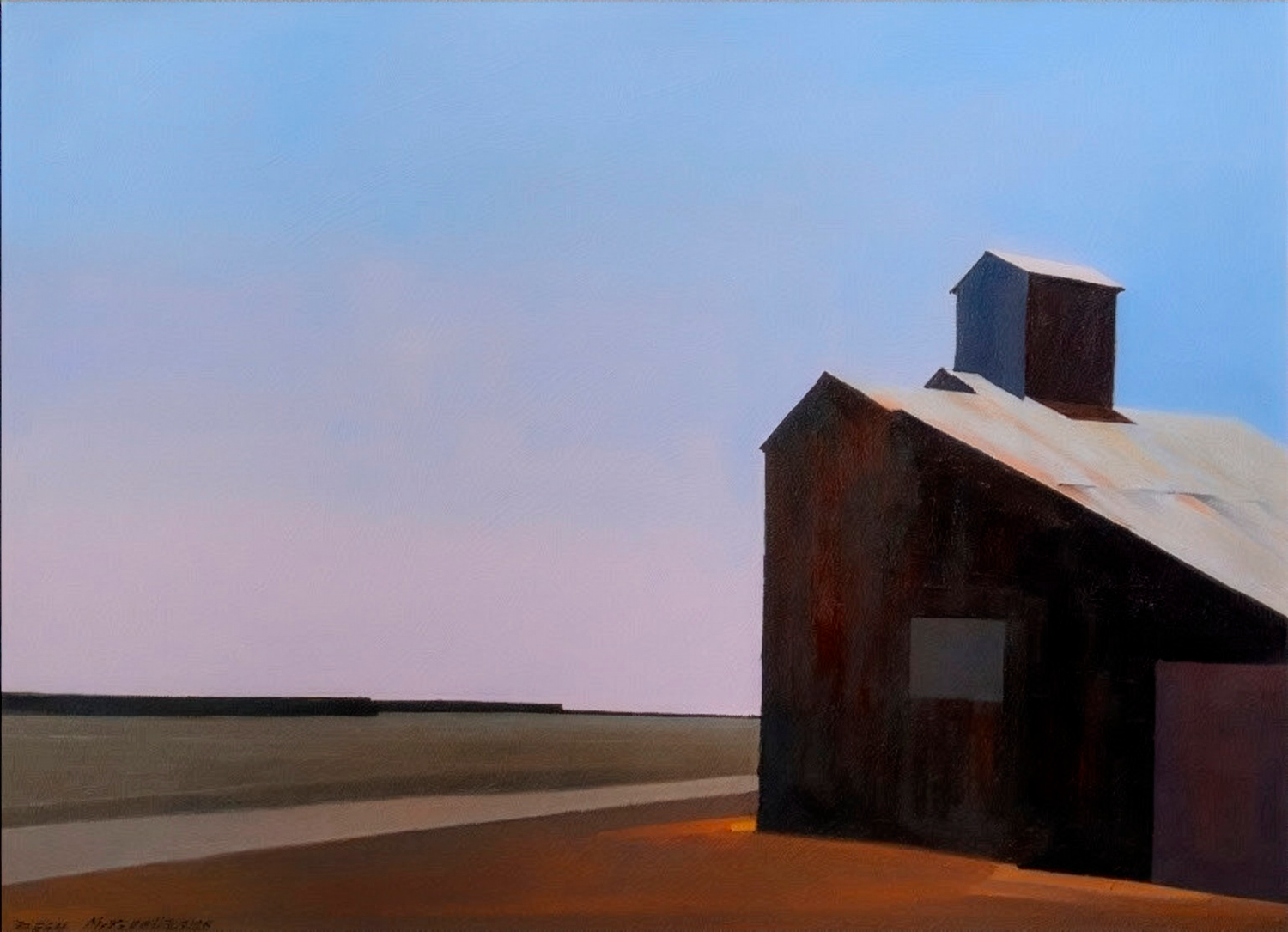
Edge of Modern, by Dean Mitchell.
But the barn and the land do not dissolve. They remain. They persist. They occupy space - on the canvas and in our consciousness. The lavender horizon, replete with subtle, sweeping brush strokes, sweeps our eye from left to right in a deepening twilight, always returning to the shadowing shape that sits solidly on the land. Weathered siding, a roofline that has endured many seasons, a glint of last light on the cupola. In the distance, a vanishing windbreak, planted generations ago by settlers who dared to accept the challenge of eking out a living on this vast landscape. The air is loud with silence.
When I view Dean Mitchell’s masterful paintings, I hear echoes of the voices of John Steinbeck, Willa Cather, Jack Kerouac, even Thoreau. These authors write of solitude, of hardship, of the power of vision that leads us inexorably onward.
As in all of Mitchell’s work, the underlying humanity is revealed. With a master’s touch, he invites us in and asks challenging questions. Where have we come from and where are we going. The past echoes as the future is foretold.