What I Look For.
Every artwork in the gallery has a reason for being. Before a piece earns wall space, it has to pass a simple—though not always easy—test. I look for three things: stopping power, a recognizable artistic voice, and staying power. When those elements come together, a work of art not only captures our attention but continues to resonate long after we’ve walked away. I need to be able to identify its unique raison d’etre in order to be able to justify giving it wall space. My eyes are constantly scanning, evaluating, editing. People often ask me, what do I look for? The answer is a simple—and not so simple—equation.
Three factors have to be present for me to say yes to an artwork.
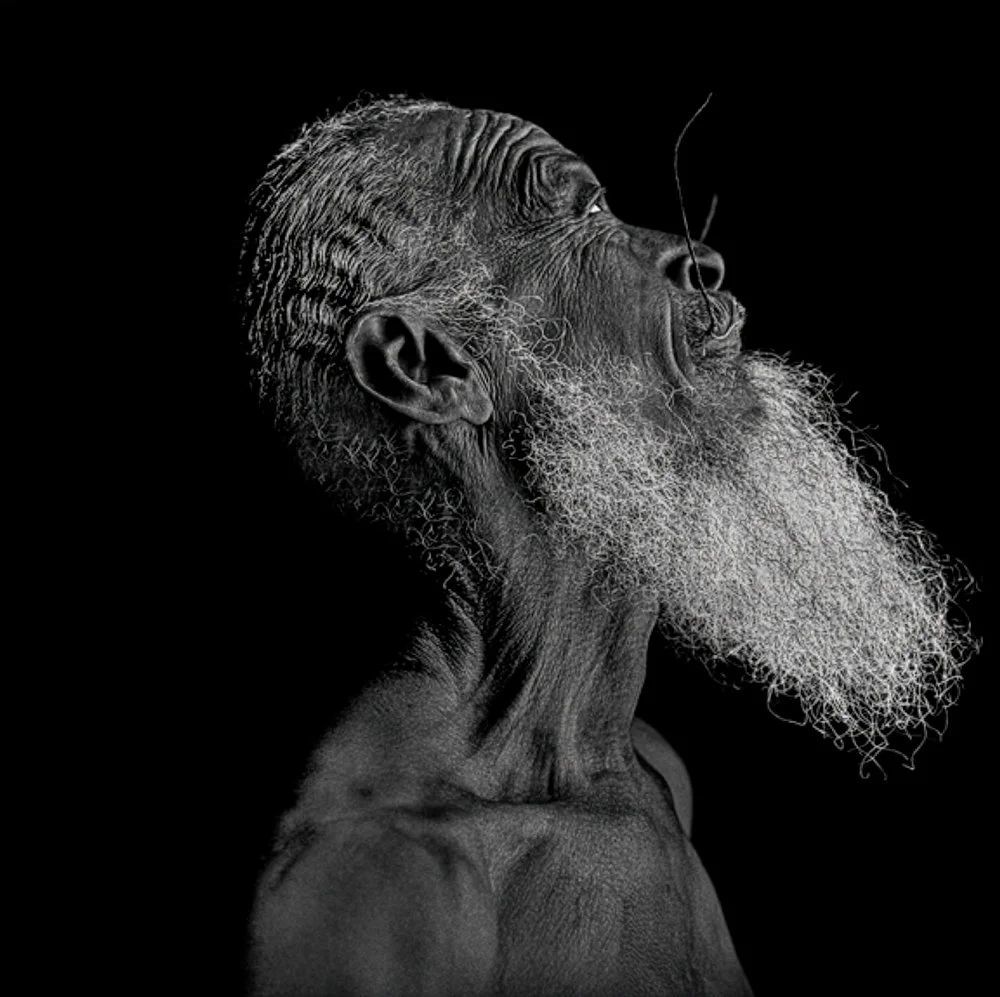
The Cobbler photograph by Lee Crum featured at Jillian Mac Fine Art
First, stopping power.
The piece has to have something about it that stops us in its tracks and makes us look twice. This could be eye-catching color, movement, a textural effect, an arresting form, or an emotion that’s being conveyed. We’re hard-wired to seek out human figures and faces everywhere we look. So it takes something special for an abstract artwork to attract us.
All artwork is essentially a mirror. It reflects what we bring to it. So it could be that the piece raises a question, or presents a mystery or enigma that our minds are already puzzling over, a what-IS-that, I-don’t-know element that isn’t easily solved or walked past. (We’ll talk more about this later, as this crosses over into the third factor.)
Next, recognizable voice.
You want the piece you’re looking at to be identifiable as the artist’s work. There should be something distinctive and consistent about their voice that helps us know what we’re looking at. What makes us recognize something is a Monet versus a Van Gogh? (This can be somewhat tricky, but it’s a skill that can be learned.)
This doesn’t mean that an artist has to repeat themselves endlessly and never grow or evolve in their work. Quite the opposite. But the evolution should be thoughtful, and the voice identifiable over time. We should be able to trace a through-line of their artistic DNA from one series to the next across what will hopefully be decades of production.
Most importantly, staying power.
There has to be enough depth and meaning, enough substance in the artwork to move us, and to keep us there for a longer, deeper look. To stay on our minds after we walk away from it. Whether it’s a sense of wonder, lingering questions that arose when we viewed it, or the repeated frisson of excitement at taking in the beauty of an artwork (whatever beauty means to us), there has to be some “There,” there.
For me, a good artwork will have all three factors present. Take away even one of the elements, and it loses its raison d’etre, its reason for being.
Eliminate the first factor, and we’ll just walk on by. If the piece can’t command our attention, make us do an initial double-take, game over.
Take away the second one and it’s a piece that, at best, falls outside the artist’s cohesive body of work. These anomalies can be a curiosity for collectors, or it may be a risky buy, as it may hold less value over time compared to other pieces in an artist’s oeuvre. At worst, its authenticity may be discredited down the road.
Take away the third element - meaning - and the piece may be pretty and distinctive looking, but it slips into the realm of decorator art and is easily forgotten.
Of course, in an ideal world, we also look for quality materials and skillful craftsmanship.
But let’s remember, some of the most arresting and valuable artworks throughout history have had what might be called mistakes, imperfections or been painted on inferior materials.
Sometimes it’s the little ‘I don’t knows’ that enhanced their notoriety. Imperfect, unfinished, or problematic artworks can still be great. (We’re looking at you, Mona Lisa, Starry Night, and anything Basquiat painted on cardboard.)
As you go through the world, try holding up these three criteria to artworks you encounter, and see what you think and, most importantly, feel.